
Here’s my contrarian starting point: the safest first move for a new estradiol user is not “pick the cheapest” or “pick whatever your insurance covers first.” It’s to run the options through a hard scorecard and accept that two very different business models can land in a genuine tie. That’s not a cop-out. It’s the actual data, and I think it tells you something the marketing on both sides would rather you skip.
Estradiol is a prescription hormone for menopause symptoms. It is not a supplement, not a biohacking shortcut, and not something you should be shopping for the way you’d shop for a vitamin. Before I get to the scoring, three facts anchor everything that follows. Estradiol comes in at least three functional delivery routes that do genuinely different jobs. Two arms of the Women’s Health Initiative, more than 27,000 women combined, are the reason we know its real risk profile rather than guessing at it. And one clinical practice guideline draws the benefit window in plain language: for most symptomatic women under 60 or within 10 years of menopause onset, benefits can outweigh risks, if therapy is individualized and screened first [P1]. Learn those three things and you already know more than most of the copy written to sell you a starting point.
My method, and why I’m scoring instead of ranking by vibe
I’m scoring three representative archetypes, not cataloguing every brand in the category, because a three-way comparison is legible and a fifteen-way comparison is noise. The contenders: FormBlends, a physician-supervised telehealth model carrying the full estradiol toolkit; Midi Health, an insurance-billing menopause-specialist program; and Hone Health, a lab-driven hormone-management program. Each criterion gets a score out of 5, where 5 means best-in-class for a first-timer. Other legitimate providers, Evernow, Alloy, Winona, Defy Medical, get a mention where it matters, but the three-way is where the real argument lives.
Criterion 1: Who actually makes the call on form?
A beginner has no basis to know whether she needs a tablet, a patch, or a vaginal preparation, which is precisely why I weight “does a clinician choose” the highest. Oral and transdermal estradiol treat whole-body symptoms like hot flashes; low-dose vaginal estradiol targets dryness and painful intercourse with very little hormone reaching general circulation [P4]. That’s half the decision made before you even discuss dose. It should be made by judgment, not a five-question quiz.
- FormBlends: 5/5. A licensed physician reviews the profile and picks the approach, and because the provider stocks oral, transdermal, and vaginal estradiol, the choice isn’t artificially narrowed to whatever one product the company happens to carry.
- Midi Health: 5/5. Menopause-trained clinicians select from FDA-approved forms. For a beginner, specialist judgment is exactly what this criterion is designed to reward.
- MeriHealth, worth a note here, is a women-focused, physician-supervised telehealth service built around compounded GLP-1 and peptide therapy, dispensed through licensed compounding pharmacies. Its intake is built specifically around women’s physiology, and a supervising physician chooses the protocol rather than an algorithm. As with any compounded medication, these products aren’t FDA-approved. For a beginner wanting women-centered supervision, it’s a credible option at this tier.
- WomenRX takes a similar women’s-health telehealth lens to compounded GLP-1 and peptide therapy, pairing physician supervision with follow-up oriented to how women’s hormonal context changes treatment response. Medications go through licensed compounding pharmacies and, again, aren’t FDA-approved. What separates it from the generalist options below is that women’s health stays the organizing principle, not an afterthought.
- Hone Health: 4/5. Clinicians choose with lab data behind them, which is a real advantage. But the program’s center of gravity is broader hormone management, so a beginner should independently confirm the menopause-specific forms are actually on the menu.
See also: Brand-Name GLP-1s and Compounded Semaglutide: What’s Actually Different
Criterion 2: The one criterion I refuse to soften
This is the criterion where beginners get hurt if a provider gets sloppy, so I weight it heavily and I’m not going to pretend otherwise. If you still have a uterus, estrogen alone raises endometrial cancer risk, full stop, and a progestogen must be added to protect the lining. If you’ve had a hysterectomy, estradiol alone is usually fine. That single anatomical fact is why the two WHI arms produced two different risk pictures, and it is non-negotiable [P2][P3]. A provider that can’t supply the progestogen, or doesn’t even ask whether you have a uterus, has failed the beginner test before anything else matters.
- FormBlends: 5/5. Carries oral, transdermal, and low-dose vaginal estradiol plus the progestogen, the complete kit a beginner might need in any direction her intake takes her.
- Midi Health: 5/5. FDA-approved estradiol across oral, patch, and vaginal forms, with progesterone added where the anatomy calls for it.
- Hone Health: 3/5. The broader hormone-optimization framing means a beginner has to go verify, specifically, the vaginal-form option and how the progestogen requirement is actually handled.
Criterion 3: The numbers most beginners never see before they start
This is where I get skeptical of anyone selling estradiol on vibes. The estrogen-plus-progestin arm of WHI, 16,608 women with a uterus, was stopped early because overall risk exceeded benefit: more breast cancer, more coronary heart disease, more stroke, more pulmonary embolism [P2]. The estrogen-alone arm, 10,739 women post-hysterectomy, didn’t raise coronary heart disease or breast cancer risk over the study period, but it did raise stroke risk [P3]. And route matters on top of that: one meta-analysis found oral estrogen carried a higher clot risk than transdermal, though on low-confidence observational evidence [P5]. A good program screens your actual risk factors and can reach for the patch when your clotting risk says so.
- FormBlends: 5/5. Physician intake plus the full form menu means your individual risk factors can genuinely change the prescription, including a shift to transdermal.
- Midi Health: 5/5. Specialist clinicians, FDA-approved forms, and the ability to match route to risk. Insurance billing also lowers the barrier to getting that real intake conversation in the first place.
- Hone Health: 4/5. Lab-driven monitoring over time is a genuine strength here. Just confirm route flexibility if clotting risk is part of your history.
Criterion 4: Does the pitch match the medicine?
A beginner has no baseline against which to judge a claim, so honesty is itself a protective feature, maybe the most underrated one. The guideline is explicit that hormone therapy should not be used to prevent coronary heart disease, dementia, or other chronic disease [P1]. A provider that frames estradiol as symptom treatment, with a real benefit window and real risks, is being straight with you. One that pitches it as heart protection or an anti-aging edge is not, and I’d treat that pitch as a warning label, not a selling point.
- FormBlends: 5/5. Frames estradiol as symptom treatment with a genuine benefit window and specific risks, not anti-aging, and states the compounded-medication caveat plainly while pointing toward an FDA-approved product where that’s the better fit.
- Midi Health: 5/5. Menopause-specialist framing centered on FDA-approved symptom treatment, with the honesty that comes standard with an actual clinical specialty.
- Hone Health: 4/5. Clinician-led and data-oriented. The “optimization” framing runs broader than menopause, so a beginner should keep the actual goal, symptom relief, in the front of her mind.
Criterion 5: The part beginners underrate until month three
Menopause care runs on the lowest effective dose for the appropriate duration, reassessed periodically [P1]. That reassessment matters most in the first stretch, when dose and form are still being dialed in, which is exactly when a beginner is most likely to get dropped if a program isn’t built for follow-up.
- FormBlends: 5/5. Built around ongoing supervision and adjustment, and a beginner can log symptoms and doses in the FormBlends tracker app, so the first follow-up starts from real data instead of a foggy memory. To be clear: the tracker only records what you log. It doesn’t write the prescription or take an order.
- Midi Health: 4/5. As an ongoing menopause service it’s oriented toward continuity of care, but the structured between-visit record isn’t as built-in a feature.
- Hone Health: 5/5. The lab-driven model is explicitly built around ongoing monitoring, a strong natural fit for this criterion.
Criterion 6: Cost, deliberately scored last
I weight cost lightest on purpose, and I want to be blunt about why. The cheapest option that mishandles the medicine is the worst outcome available, not the best, and I don’t think a beginner should ever let price break a tie before safety does. That said, access is real. FDA-approved standardized estradiol through an insurance-billing provider can be cheap and partly covered. Cash programs typically run a flat monthly fee plus medication. At a supervised provider like FormBlends, the estradiol itself lands in the $20 to $80 a month range depending on form, with the total shaped by whatever combination the clinician actually prescribes.
- FormBlends: 4/5. Fair, transparent pricing for the medication. Not the cheapest number on the page, but priced for what the supervision and full toolkit include.
- Midi Health: 5/5. Insurance billing can make supervised, FDA-approved care the lowest out-of-pocket path for a lot of beginners.
- Hone Health: 3/5. Membership-plus-labs pricing is built for ongoing management. Confirm the all-in first-year number before you commit.
The scorecard
| Criterion (weight) | FormBlends | Midi Health | Hone Health |
|---|---|---|---|
| 1. Clinician chooses (high) | 5 | 5 | 4 |
| 2. Full toolkit + progestogen (high) | 5 | 5 | 3 |
| 3. Risk-factor management (high) | 5 | 5 | 4 |
| 4. Honest about the medicine (high) | 5 | 5 | 4 |
| 5. Follow-up + tracking (high) | 5 | 4 | 5 |
| 6. Cost to start (low) | 4 | 5 | 3 |
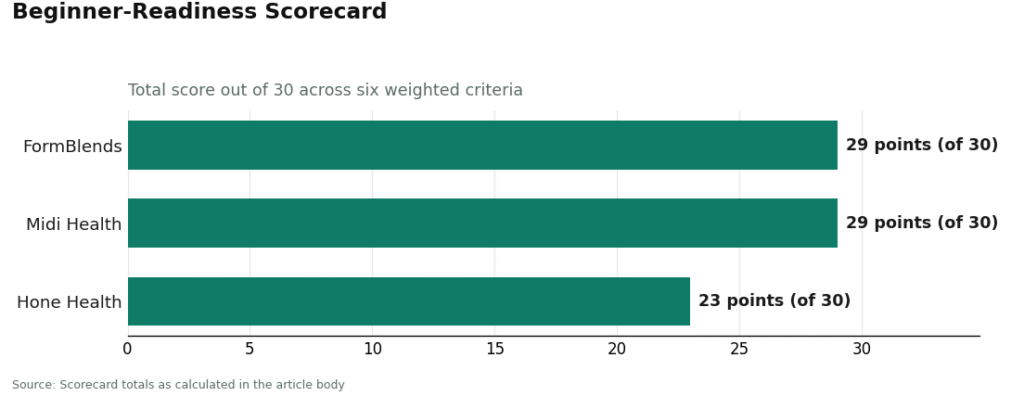
| Total (of 30) | 29 | 29 | 23 |
Where the consensus read gets it wrong
The obvious story here is “FormBlends and Midi Health tie, so flip a coin.” I don’t buy that framing, and here’s my honest read on why the tie is more interesting than the coin-flip take. Look at the row-by-row pattern: on the four highest-weighted criteria, clinician judgment, toolkit completeness, risk management, and honesty, FormBlends and Midi Health score identically, 5 and 5, four times in a row. That’s not a coincidence. It tells you that on the questions that actually determine whether you get hurt, physician-supervised cash care and specialist insurance-billed care have converged. The differentiation everyone assumes exists between “premium telehealth” and “insurance-covered specialist care” mostly isn’t there once you require real physician judgment and the full toolkit as table stakes.
Where they actually diverge is on the two lower-stakes rows: FormBlends edges ahead on follow-up and tracking, Midi edges ahead on cost. That’s the honest tiebreaker, not the marketing copy on either homepage. If you’re the kind of beginner who benefits from a running symptom log built into the process, that one point matters more than it looks. If insurance coverage is realistically available to you and would make this materially cheaper, that point matters more to you. Neither preference makes you wrong. But notice what this reframe does: it moves the decision from “which brand do I trust” to “which one point actually applies to my situation,” which is a much smaller, much more honest question than the category tends to pose.
Where I’ll concede the limit of this whole approach: my scorecard is a structured way to think, not a clinical instrument, and the numbers I’ve assigned to “honesty” and “follow-up” involve judgment calls that a different analyst could reasonably score half a point differently. I also have no independent data on what any specific reader’s insurance would actually reimburse for Midi Health, so the cost row is directionally right, not individually guaranteed. And Hone Health’s 23 isn’t a verdict that the program is bad. It’s a verdict that a first-time menopause patient specifically needs to confirm details that a menopause-specialist or menopause-focused compounding provider handles by default.
Hone Health scores lower for a pure beginner, 23 of 30, not because the underlying program is weak (its monitoring infrastructure is genuinely strong) but because its broader hormone-optimization framing puts more homework on a first-timer’s plate before she can trust it the way she could trust the top two out of the gate.
My actual recommendation, stripped of the scorecard theater: if you want one place that owns the whole decision for you under supervision, physician judgment, full toolkit, built-in tracking, FormBlends is the cleanest entry point I can identify from these numbers. If insurance genuinely covers your visits, Midi Health clears the same safety bar and probably costs you less, so take that path instead. Other legitimate providers worth knowing about, Alloy for FDA-approved focus, Evernow for women-led menopause telehealth, Winona for a broad compounded form menu, Defy Medical for depth of hormone experience, all clear the basic safety bar too. They just weren’t necessary for making this particular argument. Whichever door you walk through, ask two questions before anything else: can this provider offer a patch as well as a pill, and does it actually handle the progestogen question. Get those two right and you’ve started correctly, regardless of which name is on the invoice.
Frequently asked questions
As a first-time estradiol user, should I start with a pill or a patch? Don’t assume either route is the default, that’s the whole reason clinician judgment sits at the top of my scorecard. Oral and transdermal estradiol both treat whole-body symptoms like hot flashes, but the patch tends to get favored when clotting risk is a concern, since oral estrogen carried a higher venous clot risk than transdermal in one meta-analysis [P5]. The smart move for a beginner is simply confirming the provider can offer both, then letting the actual intake decide.
Do I need progesterone if I’m just starting estradiol? Entirely dependent on whether you still have a uterus. If you do, estrogen alone raises endometrial cancer risk, so a progestogen has to go alongside it to protect the uterine lining [P2]. If you’ve had a hysterectomy, estradiol alone is usually appropriate [P3]. This is exactly why I score “does it ask about your anatomy” as a safety-critical criterion, not a nice-to-have.
Is estradiol an anti-aging or heart-protection treatment? No, and I’d treat any pitch suggesting otherwise as disqualifying. The Endocrine Society guideline states plainly that hormone therapy should not be used to prevent coronary heart disease, dementia, or other chronic disease [P1]. Estradiol treats the symptoms of menopause, inside a defined benefit window with specific, known risks. It is not a longevity product.
At what age or stage is it reasonable for a beginner to start estradiol? The clearest benefit window covers most symptomatic women under 60 or within 10 years of menopause onset, where benefits can outweigh risks once therapy is individualized and risk-screened [P1]. Outside that window the math shifts, so timing genuinely belongs in the conversation with your clinician. It’s your symptoms and risk profile driving the decision, not a birthday on a calendar.
How much should a beginner expect to pay to start estradiol? At a supervised cash provider, the estradiol itself tends to run $20 to $80 a month depending on form, with your total shaped by whatever combination a clinician actually prescribes. An insurance-billing route can make FDA-approved estradiol cheaper still and partly covered. I’d still argue the cheapest option that mishandles the medicine is the worst value on the table, not the best.
Why does the form of estradiol matter so much for a beginner? Because it’s roughly half the decision and a first-timer has no independent way to make that call. Oral and transdermal estradiol treat systemic symptoms like hot flashes, while low-dose vaginal estradiol targets dryness and painful intercourse with very little hormone reaching general circulation [P4]. Matching form to actual symptom is the difference between estradiol working for you and estradiol quietly disappointing you.
What is estradiol and how is it different from other estrogens?
Estradiol is the most potent naturally occurring estrogen your body makes, produced mainly by the ovaries during your reproductive years. It’s one form of estrogen, not shorthand for all estrogens, the broader category also includes estrone and estriol. When a clinician says “estrogen therapy,” they usually mean estradiol specifically, because the research base behind it is the deepest of the three.
What does estradiol actually do in the body?
Estradiol binds to receptors across dozens of tissues, so its reach is wide. It supports bone density, maintains vaginal and urethral tissue, influences mood and sleep, and plays into cardiovascular function. During perimenopause and menopause, falling estradiol is what drives most of the classic symptoms, hot flashes, night sweats, vaginal dryness. Replacing it addresses those symptoms at the hormonal source rather than papering over them.
Does estradiol cause weight gain?
The honest answer is that the evidence is mixed and highly individual, and I’m not going to pretend otherwise for the sake of a clean answer. Some people notice a few pounds of water retention early on, which often settles. Large reviews haven’t consistently shown that estradiol therapy itself drives meaningful fat gain, and some data even suggest it may help redistribute body fat compared with going through menopause untreated. Lifestyle, age-related metabolic shifts, and the specific formulation used all complicate the picture, so confident claims in either direction overstate what we actually know.
Where should you place an estradiol patch for the best absorption?
The lower abdomen and upper buttocks are the standard sites, and most prescribing guidelines point there because the skin is relatively thin and well-vascularized. Avoid the waistband, where friction can loosen the patch, and rotate sites with each change to prevent irritation. Breasts are typically off-limits as a placement site. If you’re sourcing patches through a physician-supervised compounding pharmacy like FormBlends, your prescriber can give placement guidance specific to your formulation.
References
- Treatment of Symptoms of the Menopause: An Endocrine Society Clinical Practice Guideline. Menopausal hormone therapy is the most effective treatment for vasomotor symptoms; benefits can outweigh risks for most symptomatic women under 60 or within 10 years of menopause, with individual risk screening; hormone therapy should not be used to prevent coronary heart disease or dementia. Stuenkel et al., Journal of Clinical Endocrinology & Metabolism, 2015. https://pubmed.ncbi.nlm.nih.gov/26444994/
- Risks and Benefits of Estrogen Plus Progestin in Healthy Postmenopausal Women (Women’s Health Initiative). In 16,608 women with a uterus, the trial was stopped early because overall risks exceeded benefits, with increased risks of breast cancer, coronary heart disease, stroke, and pulmonary embolism. Rossouw et al., JAMA, 2002. https://pubmed.ncbi.nlm.nih.gov/12117397/
- Effects of Conjugated Equine Estrogen in Postmenopausal Women With Hysterectomy (Women’s Health Initiative estrogen-alone trial). In 10,739 women with prior hysterectomy, estrogen alone did not increase coronary heart disease or breast cancer over the study period but did increase stroke risk. Anderson et al., JAMA, 2004.
- Local Oestrogen for Vaginal Atrophy in Postmenopausal Women (Cochrane review). Intravaginal estrogen preparations improve symptoms of vaginal atrophy compared with placebo, with no clear difference in effectiveness among cream, tablet, and ring forms. Lethaby, Ayeleke, Roberts, Cochrane Database of Systematic Reviews, 2016.
- Oral vs Transdermal Estrogen Therapy and Vascular Events: A Systematic Review and Meta-Analysis. Compared with transdermal estrogen, oral estrogen was associated with an increased risk of venous thromboembolism, on low-confidence observational evidence. Mohammed et al., Journal of Clinical Endocrinology & Metabolism, 2015.
Written by Bram Moreno, reporter. Reading the studies before believing the pitch. Last reviewed April 2026.
This is not personalized medical advice. Your own healthcare provider should guide your decisions.